
Artificial Intelligence (AI) has quietly taken a seat beside today’s software developers.
Tools like GitHub, ChatGPT, Copilot, Codeium, and more, can generate boilerplate code, explain legacy functions, draft tests, and even help reason through architectural problems. In many ways, they function like a tireless pair programmer – albeit a virtual one.
Despite rapid advances in capability and accessibility, however, adoption across software development teams remains uneven.
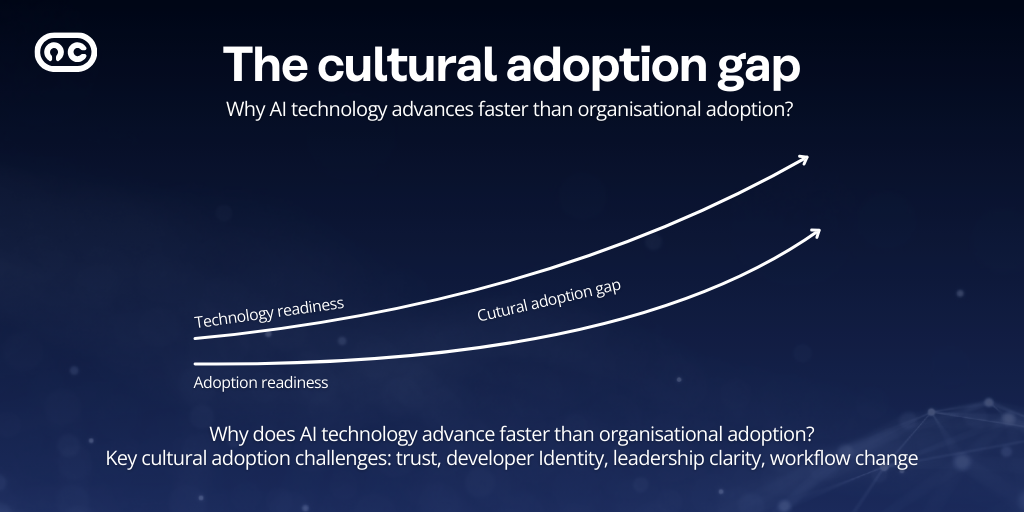
Why? Well, as we explore in this article, the biggest barriers to adoption aren’t technical. They’re cultural. We’re talking trust, embedding sense of safety, developer identity, and organisational mindset, to name a few. Typically, these challenges are proving to be far more complex than integrating another tool into the IDE (Integrated Development Environment).
So, how can organisations overcome this barrier to AI adoption?
Discover more about our Development AI Accelerator Solution
The rise of the ‘Silicon Pair Programmer’
Before we dig into the cultural barriers to AI adoption, let’s take a moment. What do we mean by the Silicon Pair Programmer?
Pair programming has long been valued for improving code quality, knowledge sharing, and problem-solving speed. Today, one half of that pair often takes the form of an AI coding assistant, in place of a human. (Hence the Silicon moniker.)
Always available, capable of instant suggestions, and increasingly context-aware, we typically see development teams using an AI-powered teammate to:
- Generate repetitive or boilerplate code
- Explore unfamiliar frameworks or languages
- Refactor or document legacy systems
- Create tests and debugging hypotheses
- Accelerate prototyping and experimentation
For experienced engineers especially, these tools often act less as replacements and more as accelerators – compressing routine tasks so more time can be spent on design, architecture, and complex problem solving.
Now, from a purely technical standpoint, the barriers to entry have dropped dramatically. Integration into major IDEs is straightforward, enterprise security controls are improving, and model performance continues to climb.
Which raises an obvious question: If the technology is ready, why isn’t adoption universal?
Is AI adoption a challenge across your organisation? If so, our specialist Development AI Accelerator solution could be the answer. From shipping code faster, to identifying friction points we’ll enable you unlock the benefits of AI-accelerated development with tailored, expert guidance.
The technology itself is no longer the barrier…
Early concerns about AI coding tools centred on accuracy, security, and maturity. Now, those concerns haven’t disappeared, but they have evolved.
Most teams now recognise that:
AI-generated code can be reviewed like any other contribution
Enterprise-grade deployment options exist
Models improve rapidly through iteration
Costs are increasingly manageable relative to productivity gains
In short, technical feasibility is no longer the primary blocker.
What remains harder, and what we are increasingly supporting our clients with, is changing how people think about their role, their craft, and their workflows.
Culture: The true adoption bottleneck
In our line of work, we’ve seen AI initiatives stall due to cultural friction. This can occur in several forms, often simultaneously.
Trust and scepticism are perhaps the most visible blockers to AI adoption. Now, developers are trained to be cautious, and rightly so. Blindly accepting generated code contradicts deeply ingrained engineering discipline. The key is for teams to have structured ways to evaluate AI output responsibly. Without this, scepticism can slide into downright dismissal.
Professional identity also plays a role. Coding is not ‘just a job’; for many engineers, it’s a craft built on years of accumulated skill. The idea that an AI assistant can produce similar output can trigger concerns about deskilling, loss of autonomy, or reduced professional value. These reactions are human, not irrational, but they need to be addressed with open discussion rather than avoidance.
Leadership ambiguity is another common barrier. Without clear policies on acceptable AI use, data privacy, or quality expectations, teams may hesitate to truly embed it. In these cases, we see teams simply avoid AI tools, to minimise perceived risk, or we see teams experiment informally without shared standards, which leads to inconsistency.
Workflow inertia shouldn’t be underestimated either. Successful development teams build habits around tools and processes that work. Introducing AI, therefore, isn’t as simple as just adding a plugin; it often changes review patterns, documentation practices, and even how problems are framed.
It’s clear that none of the above are code problems. They’re people problems.
Rovo Dev is Atlassian’s flagship AI offering designed specifically for software development teams. Read up on the Atlassian Software Collection to learn more about how Rovo Dev, Jira, DX and more combine to unlock powerful developer velocity.
Productivity gains aren’t guaranteed
There’s a persistent myth that simply deploying AI coding tools results improves productivity. The reality is, of course, more nuanced.
To truly maximise value from AI, your development teams will need to develop new skills. These could include:
Prompt formulation and iterative querying
Critical evaluation of generated code
Understanding where AI excels (and where it doesn’t!)
Maintaining architectural oversight
Teams that skip this learning phase often experience inconsistent results. Some software developers may well see dramatic speed improvements – but others will encounter friction, mistrust the output, or abandon the tools altogether.
That’s why we need to treat AI adoption as a capability-building exercise – not just a tooling rollout.
So, what are successful development teams doing differently?
Organisations that see sustained benefits from AI coding assistants tend to focus deliberately on cultural adaptation.
Normalise experimentation. Instead of mandating AI use or discouraging it, successful AI-adopters provide low-stakes opportunities to explore. We’re talking internal demos, knowledge-sharing sessions, and informal play help build familiarity without pressure.
Establish clear guardrails. You can reduce uncertainty – and the potential for non-compliance – with simple guidelines around data sensitivity, review expectations, and acceptable use. We find that teams are far more willing to engage when the boundaries are explicit.
Invest in AI literacy. Treat prompting techniques, verification strategies, and understanding model limitations as professional skills worth developing.
Keep humans firmly in the loop. Successful teams emphasise augmentation, not replacement. While AI undoubtedly accelerates execution, your developers remain accountable for quality, design decisions, and ethical considerations. The value of this cannot be understated.
Share success stories internally. Shift perceptions faster with powerful peer examples. Let’s say a team cut a debugging session from hours to minutes, completed documentation in a fraction of the usual time, or delivered faster onboarding for new hires.
Be open to feedback. Whilst certain stakeholders or leadership may welcome the idea of AI tooling, your teams on the ground may not see the value in practice. Whilst it’s unusual for AI coding assistants not to deliver faster, high quality outcomes, you do need to listen to your people. Their concerns may not solely arise to resistance to change – instead their feedback could shine a light on valid foundation processes or ways of working that need to be adapted for true AI adoption success.
Eradicate your manual tasks and improve productivity with custom Rovo Agents – each designed to fulfil a bespoke use case. Discover how organisations are using them with our AI Agent Library.
The future of the AI-augmented developer
As many of you will undoubtedly recognise, and we ourselves see across our client base, the software developer role itself is subtly shifting. Coding remains central, but orchestration is becoming equally important – knowing how to collaborate effectively with intelligent tools.
We’re very clear that this doesn’t diminish engineering expertise. Instead, it amplifies it. Strong developers are often the ones who benefit most because they can guide AI more precisely, recognise weak output quickly, and integrate suggestions into broader system thinking.
Teams that embrace this shift are likely to move faster, experiment more confidently, and reduce cognitive load on repetitive tasks. Those that resist may find themselves competing at a structural disadvantage.
Culture vs AI strategy
There’s an old management adage that culture eats strategy for breakfast. To our mind, AI adoption in software development is a textbook example.
The technology is advancing rapidly and will continue to do so. Integration challenges will keep shrinking. But trust, identity, leadership clarity, and workflow evolution require deliberate attention.
With the guidance of AI and development specialists – like our team here at Automation Consultants (AC) – you can enhance adoption of, and maximise your investment in, AI coding assistants. With 20+ years across the DevOps, Agile and Cloud space, and a global client base of 600+ innovative organisations, trust us to knock down your AI adoption barriers and guide you to long-term success.